
Introduction to Monotypes
While many of us are familiar with the more common types of printmaking such as block prints, etchings, and screen printing, monotyping is a print form that hasn’t quite made it into the popular vernacular. Monotyping is a process which removes the art from the printing surface to produce unique, one of a kind prints every time. The transfer of the image from one surface to the other often leaves behind residue and, once reprinted, creates what is known as a ghost print. This alocasia leaf example shows both the original print on the left whose higher contrast allows for more details while the aptly named ghost print on the right has faded colors and more subtle veining.
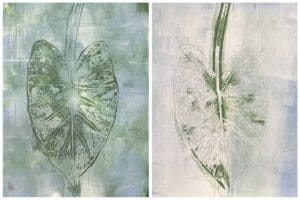
These monotypes were captured on a gel plate, a non-porous gelatin-like surface which allows for the use of stencils, subtractive mark making, and found objects like this leaf to make imprints in ink’s surface.
If you take a look around our galleries, you’re sure to see a few monotypes. Artist Kathy Cornwell uses both handmade stencils and found objects to create compositions like Plants v Plastic, a large format monotype created on Kathy’s homemade gel plate. Her process is evident in the soft edges of the print and the multitude of color layers found in the twists and folds of the source material.
Kathy takes the art of monotyping one step further by using her prints in her collage works, cutting and ripping the monotypes and combining them into something new and just as unique. If you look closely at Cornwell’s We’ll See you’ll discover the almost fossilized remains of plants and flowers that have taken on different forms and layered in just the right way to produce a beautiful new composition.
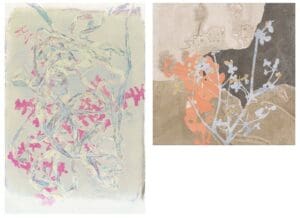
Kathy Cornwell Plants V Plastic Kathy Cornwell We’ll See
Iraima Alonso also uses monotypes in her mixed media works to emphasize their abstract and intuitive compositions. Alonso builds upon the original print by introducing and layering various elements. In Spain 6, she includes paint, pen and ink, newsprint and other papers to layer, highlight, and break past the original constraints of her monotype. Her use of the complementary orange and blue color scheme highlights the contrasting hard and soft edges created by this process.
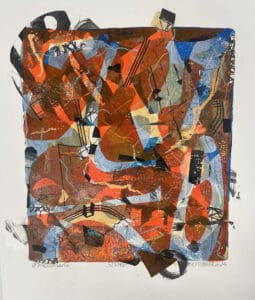
Iraima Alonso Spain 6
Monotypes can be pulled from most smooth surfaces like metal, acrylic, and glass. The variety of possibilities makes the artform accessible to all ages and skill levels. If you try monotyping out for yourself, drop by our galleries to show it off and find the perfect frame to display your new artwork!